


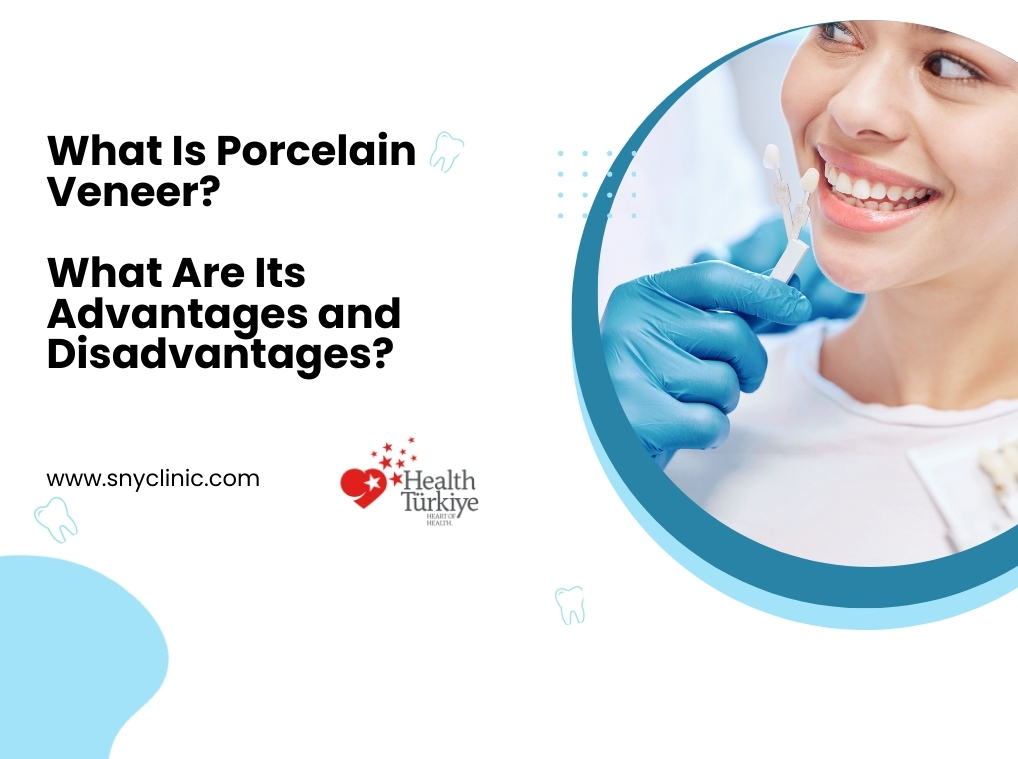
What Is Porcelain Veneer? What Are Its Advantages and Disadvantages?
What Is Porcelain Veneer (Laminate Veneer)? What Are Its Advantages and Disadvantages?
Aesthetic dentistry has made significant progress in recent years. With the increasing importance placed on smile aesthetics, interest in treatments that improve the appearance of teeth in a natural and minimally invasive way has grown rapidly. At this point, one of the most preferred aesthetic dental treatments is porcelain laminate veneers. Thanks to their natural appearance, tooth-preserving structure, and long-lasting results, porcelain veneers are considered one of the gold standards in aesthetic dentistry.
In this article, you will find clear and detailed answers to all frequently asked questions, such as what porcelain laminate veneers are, who they are suitable for, their advantages and disadvantages, how the treatment process works, and how long they last.
What Is a Porcelain Laminate Veneer?
Porcelain laminate veneers are extremely thin porcelain shells (approximately 0.3–0.7 mm thick) that are applied only to the front surface of the teeth. They are called “laminates” because they are as thin as a leaf. These veneers do not cover the entire tooth but only the visible front surface.
The goal is to aesthetically improve the color, shape, size, and alignment of the teeth and achieve a more symmetrical, whiter, and natural-looking smile. Since they require minimal intervention to the tooth structure, they stand out as one of the most conservative aesthetic solutions in modern dentistry.
Differences Between Porcelain Laminate Veneers and Other Crowns
Porcelain laminate veneers are often confused with zirconia or metal-supported porcelain crowns. However, there are important differences:
- Porcelain veneers are applied with minimal reduction only on the front surface of the tooth, without significantly reshaping the entire tooth.
- Zirconia and traditional porcelain crowns require more extensive tooth reduction.
- Porcelain veneers provide the most natural aesthetic result due to their light-transmitting properties.
- They are mainly used for aesthetic purposes and are not intended to bear heavy chewing forces on their own.
Who Is Suitable for Porcelain Laminate Veneers?
Porcelain laminate veneer treatment may not be suitable for every patient. Ideal candidates generally include individuals who:
- Have tooth discoloration that cannot be corrected with whitening
- Have gaps (diastema) between their front teeth
- Have mild crowding or shape irregularities
- Have teeth that appear short or asymmetrical
- Have chipped, cracked, or worn front teeth
- Have high aesthetic expectations
Note: Patients with severe teeth grinding (bruxism), advanced crowding, or significant bite problems may require alternative treatments.
Advantages of Porcelain Laminate Veneers
1. Natural and Aesthetic Appearance
Porcelain veneers closely mimic natural tooth enamel in terms of light transmission. This prevents an artificial look and results in a highly natural and aesthetic smile.
2. Minimal Tooth Reduction
Little to no enamel removal is required during treatment, which helps preserve the natural tooth structure.
3. Color Stability
Porcelain surfaces are resistant to staining from tea, coffee, and cigarettes, maintaining their color for many years.
4. Long-Lasting Results
With proper case selection and good oral hygiene, porcelain veneers can last 10–15 years or even longer.
5. Short Treatment Time
The treatment is usually completed in 2–3 appointments, providing much faster results compared to long orthodontic treatments.
6. Gum-Friendly
Porcelain is a biocompatible material and does not cause gum discoloration or allergic reactions.
Disadvantages of Porcelain Laminate Veneers
Like any aesthetic treatment, porcelain veneers also have some disadvantages:
1. Not Suitable for Everyone
They may not be appropriate for patients with severe crowding, major bite problems, or intense teeth-grinding habits.
2. Risk of Fracture
Due to their thin structure, veneers can fracture if used to bite hard objects or open packages with teeth.
3. Limited Reversibility
If enamel reduction has been performed, the tooth may not fully return to its original state after veneer removal.
4. Higher Cost
Because of the high-quality porcelain materials and custom fabrication, veneers can be more expensive than other aesthetic treatments.
How Does the Porcelain Laminate Veneer Treatment Process Work?
1. Examination and Planning
The dentist evaluates the oral structure, tooth condition, and patient expectations. Digital smile design may be used to plan the final result in advance.
2. Minimal Tooth Preparation
If necessary, a very thin layer is removed from the front surface of the teeth.
3. Impression Taking
Precise impressions are taken and sent to the laboratory. Veneers are custom-made for each patient.
4. Try-In Stage
The prepared veneers are temporarily placed to check fit, color, and shape, and patient approval is obtained.
5. Permanent Bonding
The veneers are permanently bonded to the tooth surface using special adhesive systems.
How Long Do Porcelain Veneers Last?
The lifespan of porcelain laminate veneers depends on factors such as:
- Oral hygiene habits
- Teeth-grinding habits
- Regular dental check-ups
- Avoiding hard foods
With proper care, durability of 10–15 years or more is achievable.
What Should Be Considered After Porcelain Veneer Treatment?
- Avoid cracking hard-shelled foods with your teeth
- Use a night guard if you grind your teeth
- Brush your teeth at least twice a day
- Do not neglect floss and mouthwash use
- Visit your dentist every 6 months for regular check-ups
Porcelain Veneers or Zirconia?
This is one of the most frequently asked questions. If front-tooth aesthetics are the priority and there is no significant loss of tooth structure, porcelain veneers provide superior aesthetic results. However, if durability and use on back teeth are the main concerns, zirconia may be preferred. The best decision should always be made by a dentist after a detailed examination.
Who Are Porcelain Laminate Veneers Ideal For?
Porcelain laminate veneers are an excellent option for individuals seeking a natural, aesthetic, minimally invasive, and long-lasting smile solution. When applied with correct case selection, by an experienced dentist, and using high-quality materials, the results are highly satisfying.
If you are unhappy with your smile and looking for a fast and aesthetic solution, porcelain laminate veneer treatment may be the ideal choice for you.
The images used in this content do not belong to a real patient. The visuals are stock photos obtained from online content provider image platforms.
Publication Date: 29.1.2026
Editor: Uğur Aktaş
Contact Number: +90 545 450 71 41
Contact Email: info@snyclinic.co