


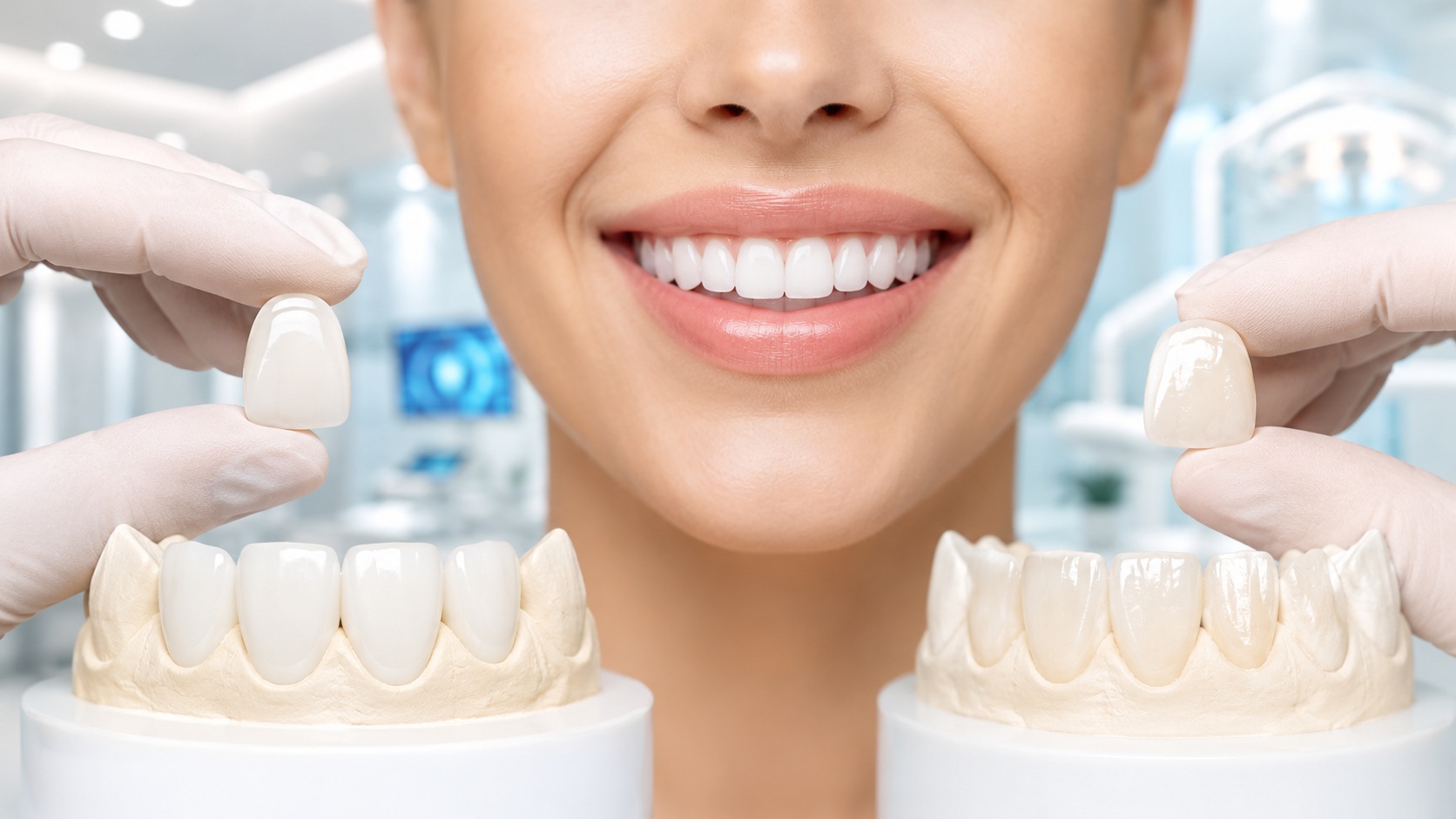
Zirconia Crowns or Porcelain Crowns: What Are the Differences?
Zirconia Crowns or Porcelain Crowns: Which Is Better?
Fractures, wear, discoloration, and shape irregularities in the teeth can affect both oral health and the appearance of the smile. In such cases, different dental crown options may be used to restore the function and appearance of the teeth.
One of the most frequently asked questions by patients considering dental crowns is: Are zirconia crowns or porcelain crowns better?
There is no single answer that applies to everyone. The most suitable crown type may vary depending on the location of the tooth, teeth grinding habits, aesthetic expectations, the amount of remaining natural tooth structure, and the patient’s bite.
What Is a Dental Crown?
A dental crown is a custom-made restoration that covers the visible part of a damaged, weakened, or aesthetically compromised tooth.
Dental crowns may be used to:
- Protect teeth with significant loss of structure,
- Strengthen fractured or cracked teeth,
- Support teeth with large fillings,
- Protect teeth that have undergone root canal treatment,
- Improve the shape and color of teeth,
- Create artificial teeth over dental implants.
Dental crowns can restore chewing function while also creating a more balanced and attractive smile. (my.clevelandclinic.org)
What Is a Zirconia Crown?
A zirconia crown is a dental crown made from zirconium dioxide, a highly durable ceramic-based material. Since it does not contain metal, it is widely used in aesthetic dentistry.
Today, zirconia crowns can be produced with different levels of translucency and strength. Monolithic zirconia crowns, which are made from a single solid piece, may be preferred for back teeth because of their resistance to strong chewing forces.
The main features of zirconia crowns include:
- High fracture resistance,
- Ability to withstand strong chewing forces,
- Metal-free structure,
- No dark metallic appearance along the gum line,
- Suitability for both front and back teeth,
- Ability to match the natural tooth color.
Zirconia is a very strong restorative material that can withstand greater forces than many other ceramic crown types. (pmc.ncbi.nlm.nih.gov)
What Is a Porcelain Crown?
The term “porcelain crown” may be used in everyday language to describe several different types of dental restorations. All-ceramic crowns, glass-ceramic crowns, and porcelain-fused-to-metal crowns may all fall under this category.
For this reason, simply describing a crown as “porcelain” may not provide enough information. It is important to determine whether the crown:
- Is made entirely from ceramic,
- Contains a metal substructure,
- Is made from a reinforced ceramic such as lithium disilicate.
All-porcelain and glass-ceramic crowns can reflect and transmit light in a way that closely resembles natural tooth enamel. Therefore, they may provide highly natural and aesthetic results, especially in the front teeth. All-ceramic and porcelain crowns are among the materials that can successfully imitate the appearance of natural enamel. (my.clevelandclinic.org)
Differences Between Zirconia and Porcelain Crowns
1. Durability
Zirconia crowns are known for their high mechanical strength. For this reason, they may be preferred for molars, dental bridges, and areas exposed to strong chewing forces.
Porcelain and glass-ceramic crowns may also provide sufficient durability for daily use. However, some porcelain materials may have a higher risk of cracking or breaking under excessive force. The American Dental Association states that porcelain may naturally be susceptible to fracture and that fracture is one of the significant complications associated with all-ceramic restorations. (ada.org)
2. Aesthetic Appearance
For front teeth, translucency, color depth, and a natural appearance are especially important. Glass-ceramic and all-porcelain crowns can provide results that closely resemble natural tooth enamel due to their high translucency.
Modern high-translucency zirconia crowns can also provide highly aesthetic results. However, some stronger zirconia types may transmit less light than glass-ceramic materials.
For this reason, the choice of material for front teeth should not be based on strength alone. The tooth color, position, smile line, and the patient’s aesthetic expectations should also be considered.
3. Areas of Use
Zirconia crowns may be preferred for:
- Back teeth and molars,
- Patients with strong chewing forces,
- Dental bridges,
- Masking dark-colored teeth,
- Cases requiring both strength and aesthetics.
All-porcelain or glass-ceramic crowns may be considered particularly for:
- Front teeth,
- Cases where high translucency is desired,
- Aesthetic treatments requiring natural color transitions,
- Single-tooth restorations.
4. Teeth Grinding and Clenching
Bruxism, commonly known as teeth grinding or clenching, may place excessive pressure on dental crowns. In patients with this habit, crown selection should not be based on aesthetics alone.
More durable restorations may be recommended for patients who grind or clench their teeth. Proper bite adjustment and the use of a night guard, when necessary, may also help protect the crowns.
5. Wear on Opposing Teeth
The surface texture of a dental crown is important because it comes into contact with the natural teeth in the opposite jaw. Ceramic restorations that remain rough or are not properly polished may cause wear on the opposing teeth.
Research suggests that properly polished zirconia surfaces may perform favorably in terms of wear on opposing tooth enamel. Therefore, laboratory quality, surface polishing, and bite adjustment are just as important as the material itself. (pmc.ncbi.nlm.nih.gov)
6. Gum Compatibility
Both zirconia and all-ceramic crowns are metal-free options. When properly planned and applied, they do not create a dark metallic reflection along the gum line.
However, gum health does not depend solely on the crown material. The fit of the crown, the quality of its margins, oral hygiene, and regular dental check-ups also directly affect gum health.
Advantages of Zirconia Crowns
The main advantages of zirconia crowns include:
- High durability,
- Suitability for back teeth,
- Metal-free structure,
- Ability to mask dark-colored teeth,
- Suitability for some dental bridge restorations,
- Availability in natural-looking shades,
- Resistance to strong chewing forces.
Disadvantages of Zirconia Crowns
Possible disadvantages of zirconia crowns include:
- Some high-strength types may be less translucent than glass ceramics,
- Proper color and material selection is necessary for a natural appearance,
- Inadequate surface finishing may cause wear on opposing teeth,
- Not all zirconia materials have the same aesthetic and mechanical properties.
Advantages of Porcelain Crowns
The advantages of all-porcelain or glass-ceramic crowns include:
- High translucency,
- An appearance similar to natural tooth enamel,
- Aesthetic results, especially for front teeth,
- Availability of metal-free options,
- Customization of color, translucency, and surface details.
Disadvantages of Porcelain Crowns
Possible disadvantages of porcelain crowns include:
- Some types may be more fragile than zirconia,
- Careful planning may be necessary for patients with strong chewing forces,
- The risk of fracture may increase in patients with teeth grinding habits,
- Not all porcelain materials are suitable for long bridges in the back of the mouth.
Zirconia or Porcelain for Front Teeth?
For front teeth, a natural appearance, translucency, and accurate color matching are particularly important. For this reason, glass-ceramic or all-porcelain restorations may provide successful results for many patients.
However, aesthetic zirconia crowns may be preferred when the natural tooth is very dark, when the underlying structure needs to be masked, or when greater durability is required.
When choosing a crown for the front teeth, the following factors should be evaluated:
- The existing color of the teeth,
- The smile line,
- The gum level,
- The number of teeth to be restored,
- The patient’s bite,
- The desired shade and translucency.
Zirconia or Porcelain for Back Teeth?
Back teeth are exposed to stronger chewing forces. Therefore, durability is an important factor when choosing a crown material for these areas.
Zirconia crowns are frequently preferred for back teeth because of their ability to withstand high forces. However, reinforced glass-ceramic crowns may also be used for certain back teeth when the patient’s bite is suitable.
The final decision should be made after evaluating the amount of remaining healthy tooth structure and the way chewing forces are distributed.
How Long Do Dental Crowns Last?
The lifespan of a dental crown does not depend solely on the crown material. The main factors that affect crown longevity include:
- Regular oral and dental care,
- Teeth grinding or clenching habits,
- Avoiding biting or breaking hard objects with the teeth,
- Proper crown fit,
- Maintaining healthy gums,
- Attending regular dental check-ups.
It is important to remember that decay may still develop in the natural tooth underneath a crown. Therefore, crowned teeth should also be brushed at least twice a day, and the spaces between the teeth should be cleaned regularly.
Are Zirconia Crowns More Expensive Than Porcelain Crowns?
The cost of dental crowns may vary depending on the type of material, the number of crowns required, the laboratory process, any additional treatments, and the complexity of the case.
Because the term “porcelain crown” covers several different materials, comparing prices based only on the name of the crown may be misleading. The exact material and full treatment plan should be clarified before making a comparison.
Should You Choose Zirconia or Porcelain Crowns?
If durability and resistance to strong chewing forces are the main priorities, zirconia crowns may be preferred. If maximum translucency and front-tooth aesthetics are the main priorities, all-porcelain or glass-ceramic crowns may be more suitable.
However, this is only a general assessment. Both materials have different subtypes with varying properties. Even the highest-quality crown may not provide the expected result if it is not properly planned, does not fit the tooth correctly, or is not maintained with good oral hygiene.
The choice of crown should therefore be based not only on the name of the material, but also on:
- The location of the tooth,
- The amount of remaining healthy tooth structure,
- Chewing forces,
- Teeth grinding habits,
- Gum condition,
- Aesthetic expectations.
A personalized treatment plan should be created after a detailed dental examination.
Both zirconia and porcelain crowns can provide successful aesthetic and functional results when used for the right patient and applied with the correct technique.
Zirconia crowns stand out for their durability, while all-porcelain and glass-ceramic crowns may offer advantages in the front teeth due to their natural translucency. The most appropriate option should be determined through a detailed oral examination, radiographic evaluation, and consideration of the patient’s expectations.
Consult your dentist to learn which crown material is most suitable for your teeth and to discuss personalized treatment options.
The images used in this content do not belong to a real patient. The visuals are stock photos obtained from online content provider image platforms.
Publication Date: 12.08.2026
Editor: Uğur Aktaş
Contact Number: +90 545 450 71 41
Contact Email: info@snyclinic.com